

The Pattern Atlas
Mapping the Logic and Essence of Living Systems

Research Overview by Rache Brand

Thesis
We rise because nature rises. Nature’s blueprint and human DNA are dimensional reflections of the same matter. We are one. When we rise with nature’s rhythms, our bodies and brains remain in patterned balance. But when we break from these rhythms, we fall into disruption: feedback loops fracture, nervous systems lock into chronic trauma, and survival-based behaviors override adaptability and creativity.
Over time, these maladaptive patterns rise into culture and systems. They become the scaffolding of economies, politics, and communities built on extraction, scarcity, and competition. The same destabilizing logic is evident in the collapse of climate systems, biodiversity loss, and social fragmentation.
The Pattern Atlas is a map for rising differently. It is both a research tool and a visual language, layering systemic maps with symbolic iconography. The tree, the spiral, the wave, the mosaic, each shows how we rise across scales, offering bridges between what can be measured and what can be felt. Through this dual method, scientific rigor meets design thinking to generate interventions that are both structurally resilient and experientially human.
To rise with nature is to realign our daily patterns with balance, adaptability, and creativity—and to embed these alignments into the very systems that shape our lives. In doing so, we restore homeostasis, strengthen collective intelligence, and replace trauma-based patterning with regenerative logic. This is how we rise: individually, societally, and planetarily—for generations to come.
Problem
The disconnection felt isn’t just a lifestyle mismatch; it’s a neurological and emotional disruption at the root level.
Here’s what’s actually happening:
When we live out of sync with nature’s rhythms, our nervous systems stay in chronic stress states (sympathetic overdrive or freeze).
This dysregulation impacts every system of the body: brain function, hormones, immune response, digestion, and cardiovascular health.
Neurologically, it impairs neuroplasticity (our ability to adapt) and locks us into reactive patterns.
Emotionally, it keeps us in a baseline of threat perception, which means we see the world through fear, scarcity, and distrust.
Over time, this internal trauma state becomes externalized into systems, the way we design our economies, our politics, our communities, embedding extraction, competition, and short-term thinking into the very structures we live under.
The result: personal illness + societal dysfunction become two sides of the same coin.
The real problem is not simply that we’ve disconnected from nature, it’s that this disconnection is traumatizing us as a species, and that trauma is self-reinforcing through the systems we create.
Executive Summary
Modern life has severed the patterned feedback loops that once connected humans to nature. This rupture induces chronic trauma, persistent nervous system dysregulation, that reshapes brain architecture, limits adaptability, and encodes survival-driven behaviors into the fabric of daily life. We are designed for homeostasis, rhythm, and resilience. Yet we have idolized icons of success that deny nature’s logic, built systems of comfort and control that erode community, and forgotten our need for unstructured time, creativity, sleep, and movement.
These maladaptive patterns do not stop with the individual. They scale into cultural defaults—economies, politics, and institutions designed around extraction, scarcity, and competition. The instability we now see in climate systems, ecosystems, markets, and governance mirrors this internal fragmentation.
The Pattern Atlas offers a framework to reverse this trajectory. It begins from the premise that human DNA and nature’s blueprint are dimensional reflections of the same matter. By realigning with nature’s patterns, we can restore homeostasis to body and brain, expand adaptive capacity, and design systems that thrive across generations.
This work identifies ten universal patterns: branching and networks, scaling, rhythm, edges, renewal, feedback, polycentrism, seasonal cycles, hybridity, and memory. These 10 patterns are the core logic of resilience. Each pattern functions as both scientific truth and cultural icon, a bridge between measurable systems and lived experience. Replacing trauma-based patterning with regenerative patterning is not just biological repair; it is cultural redesign.
This restoration requires reclaiming the generative forces that have always renewed life: oscillation, relationship, pleasure, and creativity. It calls for integrating historic, ancient, indigenous, spiritual, and modern models into a multidimensional view of human systems. It also demands an iconography shift, from narrow archetypes of power and success to symbolic belonging rooted in nature’s design.
Across cultures and epochs, renewal has been represented in spirals, blossoms, mosaics, and branching forms, encoding the truth that resilience depends on reciprocity and exchange. By re-embedding these symbols into governance, education, health, and the economy, we can create systems that remind us daily of our shared logic with life itself.
When humans live in recognition of these patterns, trauma unwinds, creativity flourishes, trust deepens, and resilience strengthens. The Pattern Atlas is both a research tool and a visual language for this transformation: a map for rising differently, individually, societally, and planetarily. We remember, at last, that we are already Rich by Nature.
Pattern Atlas Terms & Focus Areas
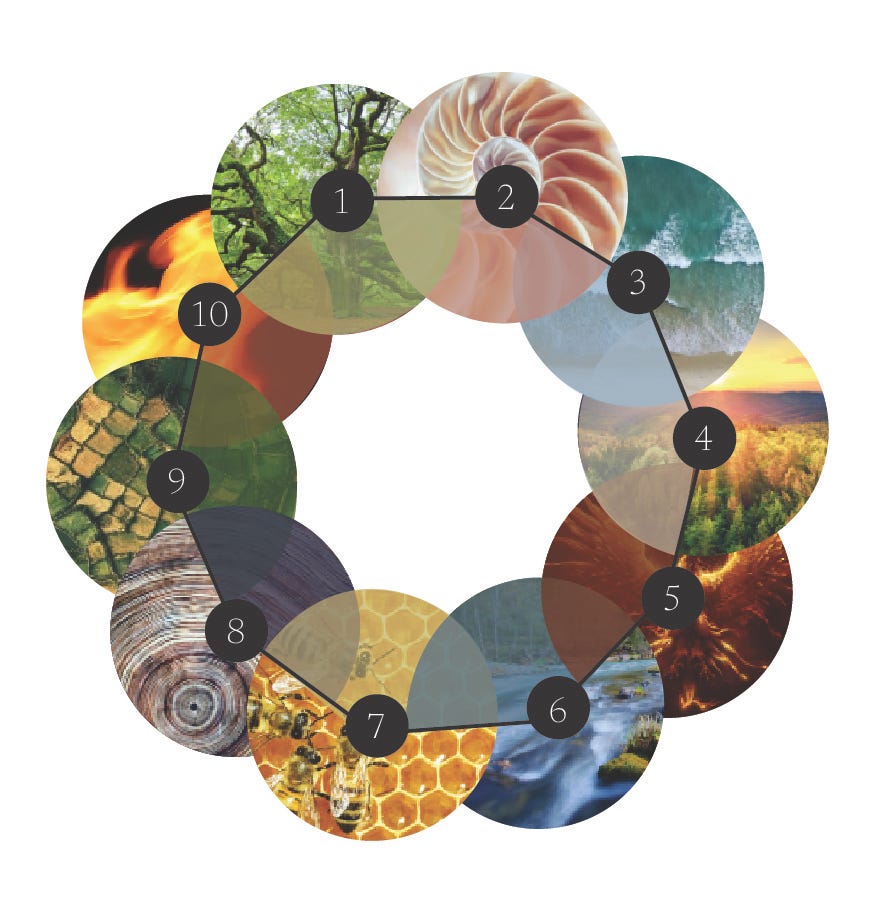
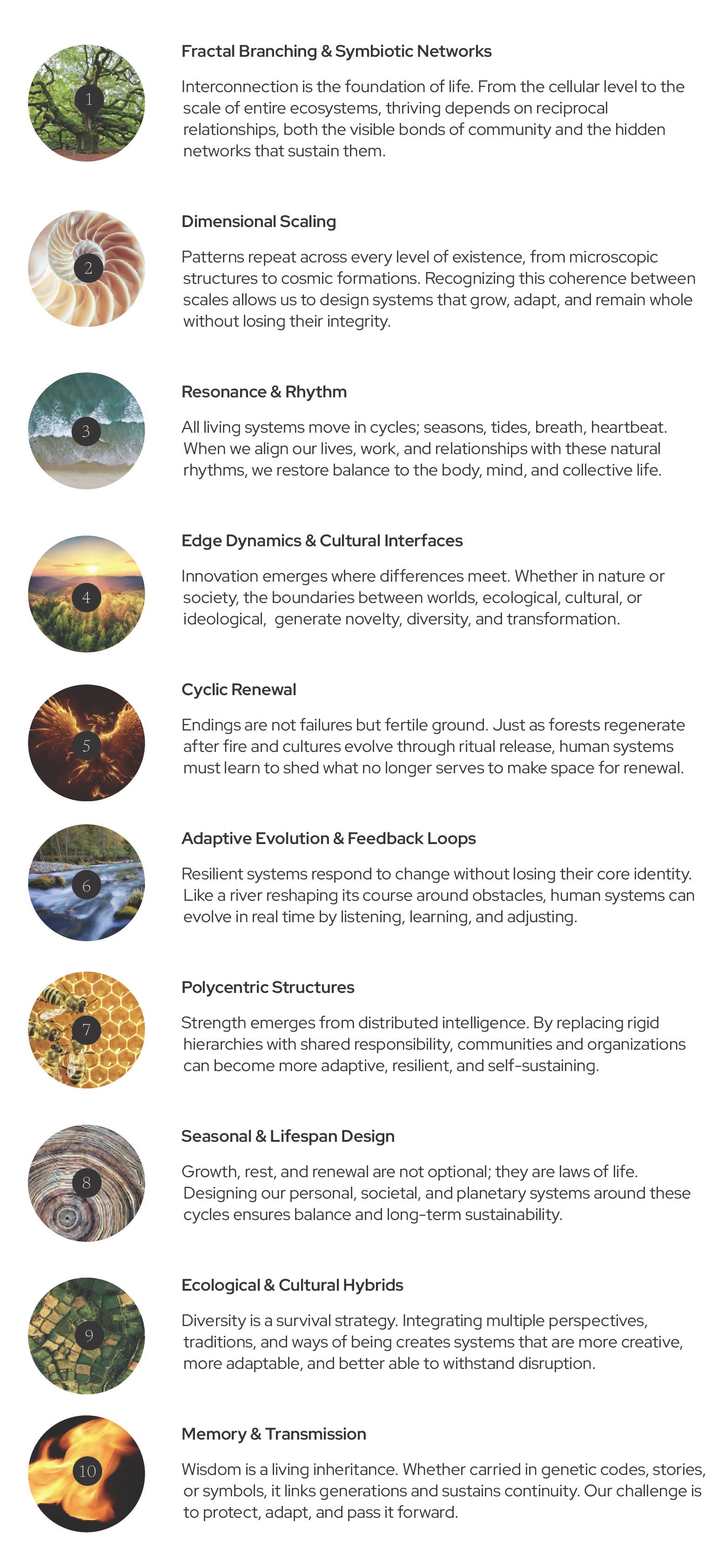
By replacing trauma-based patterning with regenerative, nature-aligned systems, humans can restore balance within themselves, and in doing so, restore balance to the systems that sustain life on Earth.
Trauma
Trauma, at its most fundamental level, is a lasting imprint on the nervous system caused by an overwhelming experience, one that exceeds our capacity to process, integrate, or return to baseline safety.
It’s not just “something bad happened.” Trauma is what happens inside you as a result:
The nervous system stays stuck in survival mode (fight, flight, freeze, or collapse).
The brain rewires itself to prioritize threat detection over growth, curiosity, or connection.
The body stores the physiological “memory” of the event, changes in stress hormones, immune function, muscle tension, digestion, etc.
The mind forms adaptive patterns (beliefs, behaviors) that help you survive short-term but often harm long-term health and relationships.
Trauma can be:
Acute → one overwhelming event (e.g., accident, loss, assault).
Chronic → repeated stress over time (e.g., unsafe home, poverty, discrimination).
Complex → layered or prolonged exposures that shape development and identity.
Intergenerational → patterns of dysregulation passed through parenting, culture, or even epigenetics.
Trauma changes patterns: physiological, neurological, and behavioral. When the whole species is living out of sync with nature’s rhythms, it’s like we’re in a collective trauma state:
Biological: chronic stress chemistry, poor recovery.
Neurological: reduced neuroplasticity, more reactivity.
Emotional: heightened fear, isolation, mistrust.
Systemic: economies and politics built around extraction, competition, and short-term gain.
Other words that also mimic this tone:
Dysregulation → scientific and precise; describes the nervous system being out of balance.
Disruption → accessible; shows a break in natural functioning without implying irreparable damage.
De-patterning → suggests we’ve lost healthy patterns; ties well to your Nature Imprint framing.
Fragmentation → evokes both the internal (emotional/mental) and external (societal/systemic) breakdowns.
Instability → links to both neurological instability and systemic instability.
Erosion → shows gradual loss of resilience, function, and integrity over time.
Disconnection → softer, universal, but may feel too mild unless paired with a stronger modifier (e.g., deep disconnection).
Maladaptation → biological term; shows that our current adaptation strategies are harmful.
Degeneration → clear cause/effect; signals decline in function across systems.
Pattern Making
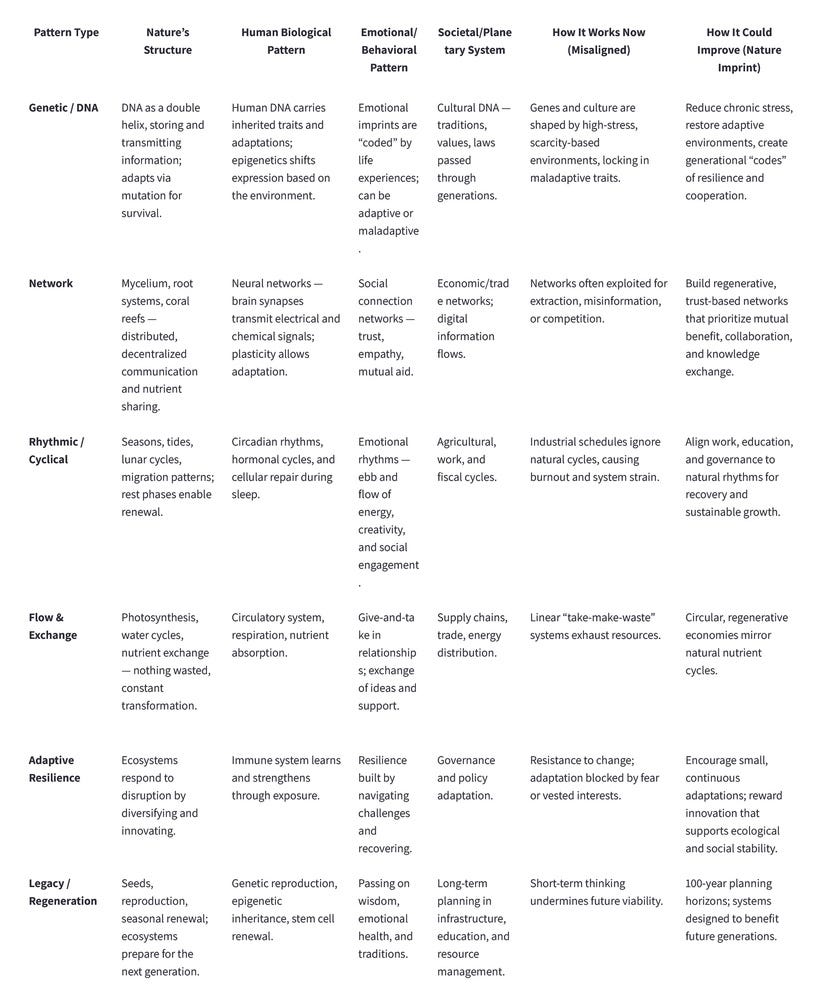
Nature ↔ Human Patterns: Current State vs. Potential Alignment
All levels, DNA, networks, cycles, flow, adaptation, legacy, share the same structural logic in nature and human systems.
Misalignment occurs when we break reciprocity, ignore cycles, or centralize control instead of distributing it.
Nature Imprint’s improvement path = restore reciprocity, follow cycles, diversify inputs, decentralize networks, and prioritize long-term generativity.
The Iconography Shift:
From Binary Archetypes to Pattern-Based Belonging
For centuries, our dominant cultural icons have been two-dimensional and polarizing:
The white-collar archetype the “pinnacle” of societal success: a suit, a corner office, linear productivity, economic dominance. Often aging, often driven by fear and filled with anger.
The underworld archetype: the wanderer, the artist, the taboo-breaker, often framed as unproductive or existing outside “real” society. Often unkempt, driven by freedom, and filled with joy.
These archetypes reinforce separation. They assign value based on conformity to one of two opposing identities, which shapes everything from education to governance. The result: we divide ourselves into “acceptable” and “marginal” ways of being, eroding the possibility of unity.
If we look at the health of our society, we are mimicking the qualities of the white-collar archtype and it is not serving our ability to survive. We have traded quality of life for individuality and societal success instead of commuinty and love. And falling into the underworld would not solve this issue either, it promotes the extreme.
Nature’s Patterns as New Cultural Icons
The Pattern Atlas offers a third way: a shared symbolic language grounded in natural systems and dimensional relationships. Instead of defining ourselves against each other, we define ourselves in connection to life’s core patterns.
For example:
Fractal Branching becomes the symbol for the distribution of care and resources: from blood in our veins to equitable food systems.
Symbiotic Networks becomes the symbol for mutual thriving: from mycorrhizae to cooperative economies.
Edge Dynamics becomes the symbol for innovation through diversity: from ecotones to cultural borderlands.
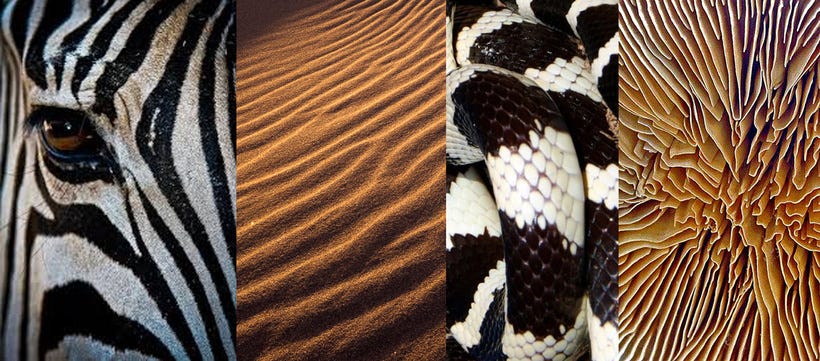
Each pattern functions as both a scientific truth and a visual icon. This duality means they can be used in policy design, education curricula, architecture, and public art, creating constant visual reinforcement that we are one system, one organism, many forms.
Practical Narrative Shifts
Replace “career ladders” with fractal trees, showing many paths upward and outward, none more “valid” than another.
Replace “top-down management charts” with mycelial maps, illustrating shared leadership and nutrient flow, the endless discovery and interconnectivity.
Replace “gated communities” with edge habitats, encouraging permeability and mutual exchange.
A Future of Shared Symbols (Patterns)
Imagine a school where the walls are painted with DNA spirals alongside river deltas, children learning that their bodies and the planet’s waterways follow the same branching logic.
Imagine a workplace whose performance reviews are structured like seasonal cycles, periods of growth, rest, pruning, and renewal.
Imagine a dating app where relationships are mapped not as “monogamy vs. polyamory” but as ecosystems, each unique, each valid, each requiring balance and care.
“We need new icons; new patterns of understanding to remember we are all just from the same star dust.” — Rache Brand
1. Fractal Branching & Symbiotic Networks
Nothing in nature thrives alone; every element supports and is supported by the whole. As Rachel Carson wrote, “In nature, nothing exists alone.” Fractal branching maximizes reach with minimal cost (rivers, bronchi, dendrites); symbiotic networks distribute resources and information (mycelium, glia, mutual aid). Human health follows the same law: body, brain, relationships, economy, and environment are inseparable. Thriving demands that all dimensions be nourished together.
In Practice
Nature: Mycorrhizal networks linking trees into nutrient-sharing communities; river deltas distributing flow with built‑in redundancy.
Body/Brain: Gut–brain axis where microbiome diversity shapes mood and cognition; dendritic arborization and glial support sustaining neural communication.
Culture: Kibbutz/coop models that integrate labor, childcare, and food systems; indigenous stewardship where land, ceremony, and governance form a single system.
Core Areas of Research
Biomimicry & Systemic Redundancy – Study how fractal and distributed designs in nature optimize resilience and efficiency; test urban infrastructure or supply-chain designs against these principles. Reference: Janine Benyus, Biomimicry Institute.
Network Interdependence – Measure health, productivity, and adaptability in human communities with high degrees of mutual aid and shared resources versus individualistic models. Reference: Elinor Ostrom on commons governance and John Fullerton from the Capital Institute.
Bio–Psycho–Social Coupling – Investigate how disruptions in environmental health directly impact nervous system regulation, immune function, and collective mental well-being. Reference: Stephen Porges on polyvagal theory.
Cross-Domain Feedback Loops – Map how changes in one domain (e.g., biodiversity loss) ripple into human health, economic stability, and cultural cohesion, identifying leverage points for intervention. Reference: Donella Meadows on leverage points.
Longitudinal Interdependence – Track multi-decade outcomes for communities embedding interconnection into policy, education, and land management. Reference: Robin Wall Kimmerer on reciprocity in ecosystems.
Future
Cities, schools, and clinics operate like forests: circular flows of energy, water, food, and data; redundancy that prevents single-point failure; cooperation rewarded at every scale. Public health couples nervous‑system regulation with environmental quality and community trust. We stop “fixing” parts in isolation and design for the health of the whole—so no node fails alone, and every improvement propagates through the network.
2. Dimensional Scaling
Natural systems display recurring proportional patterns across vastly different scales — a concept known as dimensional scaling. Spiral galaxies mirror the double helix of DNA; the branching patterns of lightning resemble neuronal dendrites; the curve of a nautilus shell echoes the folding of the cochlea in the human ear. These repeating geometries are not aesthetic accidents; they are functional, optimizing stability, energy use, and information flow.
The human brain is itself a master of dimensional scaling: cortical folds maximize surface area for processing power, while the organization of neural networks follows similar mathematical principles to river deltas and mycelial webs. When we design human environments to follow these patterns, we create spaces that feel intuitively harmonious and support cognition, emotional regulation, and collaboration.
“In nature, the same patterns occur over and over again, in our bodies, in plants, in the cosmos, because they work.” — Janine Benyus
In Practice
Biophilic architecture: buildings designed using the Fibonacci sequence to create proportion and flow.
Medical imaging: mapping the fractal geometry of bronchial and vascular systems to diagnose disease earlier.
Urban design: cities planned with proportional scaling between neighborhoods, transit routes, and central hubs to balance density with livability.
Core Areas of Research
Biophilic Design Benefits – Measure the cognitive, emotional, and physiological impacts of biophilic architecture in schools, workplaces, and hospitals, assessing outcomes such as learning, recovery, and stress regulation. Reference: Stephen Kellert; Janine Benyus.
Spatial Cognition & Memory – Explore how the brain encodes spatial patterns and environments, linking neuroscience of pattern recognition to navigation, memory formation, and emotional regulation. Reference: Antonio Damasio; Lisa Feldman Barrett.
Fractal Urban Modeling – Apply mathematical modeling of fractal structures found in ecological and neural networks to enhance resilience and efficiency in urban planning and infrastructure design. Reference: Ilya Prigogine.
Future
Cities, communities, and digital networks could be designed with the same scaling principles as coral reefs or the human brain, creating living systems where information, resources, and relationships flow effortlessly. Workplaces could follow proportional designs that reduce stress and increase productivity, while virtual worlds could be built to mirror natural geometries, enhancing mental health rather than depleting it. In this future, built and digital environments would act as cognitive allies, reinforcing neural health through their very form.
3. Resonance & Rhythm
All life is governed by rhythm. From the pulsing of the heart to the migration of whales, from the phases of the moon to the neural oscillations that underpin thought, rhythm is nature’s metronome. These cycles, circadian, seasonal, tidal, and even millisecond-level brainwave patterns, are not just background features of life; they are the organizing principles that allow organisms to synchronize with their environment.
In the human body, rhythmic regulation happens at multiple layers: the suprachiasmatic nucleus of the brain keeps time with light-dark cycles; the autonomic nervous system syncs breath and heart rate for emotional stability; and ultradian rhythms orchestrate alternating bursts of energy and rest throughout the day. When these rhythms are disrupted, through irregular work hours, artificial light exposure, or chronic stress, the nervous system loses its baseline stability, leading to dysregulation in mood, immunity, and cognition.
Nature thrives by staying in tune with its own metronome, and so do we. Societies that design life around natural timing, harvest festivals, communal rest periods, or even synchronized fishing and planting cycles, not only preserve resources but also foster communal cohesion and psychological resilience.
“Rhythm is the way life expresses balance, the dance between activity and rest, chaos and order.” — Fritjof Capra
In Practice
Workplace design: shifting office schedules to align with circadian energy peaks for better focus and decision-making.
Community agriculture: crop cycles and food distribution that mirror seasonal abundance and scarcity.
Therapeutic interventions: using breathwork and heart-rate variability training to restore autonomic rhythm.
Core Areas of Research
Research questions should explore both biological synchrony and social synchrony:
Rhythm Disruptions & Cognition – Study how circadian and ultradian rhythm disruptions from shift work or jet lag affect emotional regulation, stress load, and long-term cognitive health. Reference: Andrew Huberman; Antonio Damasio.
Collective Rhythm & Cohesion – Examine the role of music, dance, and synchronized labor in fostering group cohesion, emotional resilience, and shared identity. Reference: Robin Dunbar; Ruth Feldman.
Chrono-Urban Design – Test how aligning city lighting, work hours, and transport systems with natural light cycles impacts public health, productivity, and ecological balance. Reference: Stephen Kellert; Vandana Shiva.
Resonant Pacing – Investigate how resonance in natural systems, such as tides or insect choruses, can inform healthier pacing and oscillation in human activity cycles. Reference: Janine Benyus; Brian Swimme.
Future
Imagine a society where public policy, city planning, and digital technology are built to align with biological and planetary cycles. Schools would open later in winter to match adolescent circadian rhythms; energy grids would ebb and flow with tidal or solar cycles; wearable devices would guide individuals to work, rest, and socialize in alignment with their body’s natural phases. This harmonization could reduce burnout, enhance creativity, and improve collective decision-making — creating a civilization in step with the rhythms that have sustained life for billions of years.
4. Edge Dynamics & Cultural Interfaces
Life’s most fertile spaces are not at the center of a single habitat, but at the edges where two or more systems meet — the shoreline between ocean and land, the border between forest and grassland, the place where cultures or disciplines intersect. These “edges,” or ecotones in ecology, are zones of heightened complexity and creativity. Diversity converges here, sparking novel solutions and adaptations.
In human society, edges appear in both physical and conceptual form: the multicultural neighborhoods where languages blend, the interdisciplinary labs where artists and scientists collaborate, the intentional communities that blend traditional agriculture with modern governance models. These are spaces where boundaries are porous, where new possibilities emerge not in spite of difference but because of it.
In the brain, edge dynamics occur in neural integration hubs, regions where sensory, emotional, and cognitive inputs converge. Here, cross-talk between networks allows us to innovate, adapt, and problem-solve in ways that single-track thinking cannot. The same applies in culture: the more channels of difference we allow to meet, the more resilience and creativity our systems can generate.
“Creativity is the unexpected offspring of difference meeting difference.” — Gregory Bateson
In Practice
Ecological: The Great African Rift Valley, a biodiversity hotspot born from the meeting of multiple ecosystems.
Urban: Border markets where goods, traditions, and languages merge into hybrid economies.
Social: Polyamorous or communal living arrangements that break conventional boundaries and create more fluid, adaptive relationship systems.
Organizational: Cross-sector think tanks bringing scientists, policymakers, and indigenous leaders together to solve climate adaptation challenges.
Core Areas of Research
Research questions should look at how edges produce adaptability and resilience:
Ecotonal Resilience – Investigate how ecological ecotones (transition zones between ecosystems) sustain higher biodiversity and adaptive capacity under climate stress, and test their applicability to conservation and urban planning. Reference: Janine Benyus; James Lovelock.
Cross-Disciplinary Synergy – Measure how heterogeneous, cross-disciplinary teams outperform homogeneous groups in problem-solving, creativity, and innovation metrics across sectors. Reference: Margaret Wheatley; Fritjof Capra.
Cultural Interface Exposure – Study whether immersive residencies and exchange programs increase cognitive flexibility, empathy, and cultural adaptability in participants. Reference: Lisa Feldman Barrett; David Graeber.
Neuro-Edge Environments – Examine how the nervous system responds in predictable settings versus edge-like or novel environments, mapping impacts on stress regulation and resilience. Reference: Bessel van der Kolk; Ruth Lanius.
Future
A future built on edge dynamics would design its borders as bridges, not barriers. Cities would cultivate “interface districts” where art studios, research labs, and street markets are intentionally co-located to maximize cross-pollination. Education systems would pair radically different disciplines from early schooling, medicine with music, engineering with anthropology, to foster edge thinking from childhood. Even governance could adopt “interface chambers” where indigenous councils, technologists, and community activists meet regularly to co-create policy. The result: a civilization fluent in difference, adaptive to disruption, and endlessly generative.
5. Cyclic Renewal
In nature, growth and decay are inseparable. Forests burn, only to regenerate richer soil; coral reefs bleach, then slowly recolonize; old cells die so new cells can form. This death–rebirth cycle is not a flaw in the system — it is the system. Without pruning, there is no flourishing. Without rest, there is no sustained productivity.
Human systems, however, often reject this principle. We demand perpetual growth from our economies, our organizations, and even ourselves, leading to burnout, depletion, and collapse. Yet biology, ecology, and indigenous wisdom remind us that cycles of contraction, rest, and renewal are essential to resilience.
In the human body, neurogenesis and synaptic pruning ensure that neural networks remain efficient and adaptive. In communities, rituals and seasonal breaks realign collective energy and purpose. In healthy governance, term limits and institutional “rest phases” keep systems agile and prevent decay from calcifying into dysfunction.
“The forest is not a static thing; it is an event, continually remade by the death of its parts.” — Robin Wall Kimmerer
In Practice
Ecological: Boreal forests using wildfire as a regeneration catalyst.
Biological: Monthly endometrial shedding in humans, part of reproductive health.
Cultural: Jewish Shmita year, where farmland rests every seven years.
Organizational: Companies adopting scheduled sabbaticals for all employees to prevent burnout and spark creativity.
Core Areas of Research
Key questions would aim to understand how cyclic rest phases increase system longevity and performance:
Successional Renewal – Explore parallels between ecological succession after disturbance and the renewal cycles of human organizations, identifying patterns that foster long-term adaptability. Reference: Fritjof Capra; Janine Benyus.
Cultural Rest Rhythms – Investigate how sabbaticals, festivals, and seasonal closures contribute to social cohesion, collective identity, and creative flourishing. Reference: David Graeber; Gregory Cajete.
Neurobiology of Rest – Measure the cognitive and neurobiological impacts of deliberate rest phases on problem-solving capacity, innovation, and emotional regulation. Reference: Andrew Huberman; Antonio Damasio.
Dormancy Economics – Test economic models that integrate intentional slow or dormant phases, assessing whether resilience and productivity can be preserved or even enhanced. Reference: Charles Eisenstein; Elinor Ostrom.
Future
In a renewal-based civilization, economic indicators would track regenerative capacity rather than only output. Work calendars would be structured with seasonal downtime for skill replenishment, cultural celebration, and land restoration. Education would have built-in “reflection seasons” where students synthesize and apply knowledge before taking on new content. Large-scale infrastructure — from transportation to data networks — would have intentional “maintenance cycles” designed into their operation, extending their lifespan and reducing emergency failures. In short, we would measure health not by constant motion, but by the integrity of our return.
6. Adaptive Evolution & Feedback Loops
In living systems, survival isn’t about strength or speed, it’s about adaptability. From bacteria developing antibiotic resistance to human cultures evolving new norms, adaptive evolution is a continual process of sensing, responding, and refining. The mechanism that enables this is the feedback loop, a system’s ability to monitor its own state and adjust accordingly.
Nature rarely relies on fixed rules. Wolves regulate deer populations, which in turn protect plant diversity; ocean temperatures shift weather systems, which influence species migration. Similarly, in the human brain, homeostatic feedback balances hormone levels, while the vagus nerve regulates stress responses. Without feedback, systems drift into imbalance and collapse.
Human institutions, however, often operate on outdated assumptions, resisting change until forced by crisis. By embedding feedback loops into governance, economies, and communities, we can move from reactive firefighting to proactive adaptation.
“The systems that survive are those that can learn faster than the rate of change in their environment.” — Donella Meadows
In Practice
Ecological: Predator-prey dynamics maintain balance in ecosystems.
Biological: Immune adaptation to new viruses through antigen memory.
Cultural: Participatory budgeting allows citizens to directly shape local spending.
Technological: Machine learning algorithms refining outputs based on user feedback.
Core Areas of Research
Key questions would focus on how real-time sensing and adaptation can be embedded into human systems:
Decentralized Governance Feedback – Investigate how ecological feedback systems maintain stability without central control, and test applications for adaptive governance models. Reference: Elinor Ostrom; Fritjof Capra.
Neuroplastic Education – Apply insights from neuroplasticity research to redesign education systems that can flexibly adapt to rapidly changing knowledge and societal needs. Reference: Lisa Feldman Barrett; Ruth Lanius.
Climate Feedback Channels – Identify and evaluate the most effective feedback mechanisms for coordinating large-scale climate adaptation across ecosystems, communities, and policy. Reference: James Lovelock; Janine Benyus.
Balanced Policy Loops – Design governance feedback loops that minimize both overreaction and inertia, improving stability and responsiveness in policy-making. Reference: Donella Meadows; Charles Eisenstein.
Future
In a feedback-integrated society, cities would self-regulate energy use by sensing real-time demand, educational systems would instantly adapt curricula to emerging skills, and economic policies would shift dynamically with environmental data. Personal health devices could integrate neural, physiological, and environmental inputs to recommend lifestyle adjustments before illness develops. These systems wouldn’t just respond to crises, they would anticipate them, creating cultures that evolve in rhythm with the world rather than chasing after it.
7. Polycentric Structures
In both nature and human life, resilience comes from distributed relationships rather than singular points of control. In a healthy forest, no single tree governs — instead, a mycorrhizal network connects roots across species, allowing nutrients, warnings, and chemical signals to flow freely. In the human body, the brain itself is polycentric, with multiple specialized hubs sharing authority.
In societies, polycentric structures replace rigid hierarchies with networks of trust and mutual reliance. Instead of one leader holding all power, decision-making is spread across many nodes — whether those are neighborhoods, cooperatives, families, or autonomous teams. These structures reduce fragility: if one hub fails, others continue the work.
Relational depth, the emotional equivalent of mycorrhizal exchange, is what makes polycentric systems thrive. It’s not just about having many relationships, but having trust-based, reciprocal ones that can withstand stress. Models like the kibbutz, polyamorous relationship networks, and indigenous clan systems show that intimacy and cooperation can be scaled across different dimensions of life.
“We are not separate from each other, but parts of a vast living system.
Our relationships are the threads that hold the fabric together.” — Fritjof Capra
In Practice
Ecological: Coral reefs act as decentralized habitats with many micro-ecosystems.
Biological: The enteric nervous system (the “second brain”) operates semi-independently from the central nervous system.
Cultural: Mondragon Corporation in Spain, a worker-owned cooperative network of over 80,000 members.
Social: Kibbutz communities share resources and decision-making collectively.
Relational: Polyamorous networks built on explicit communication, trust, and mutual care.
Core Areas of Research
Key questions would explore how polycentric and trust-based systems enhance resilience:
Polycentric Power – Explore how polycentric governance distributes authority across multiple nodes while maintaining coordination, and apply findings to global governance challenges. Reference: Elinor Ostrom; Margaret Wheatley.
Generational Trust Networks – Study how small-scale, high-trust societies such as kibbutzim or indigenous clans maintain stability and resilience across generations. Reference: Gregory Bateson; Robin Wall Kimmerer.
Relational Depth & Resilience – Examine how deep relational bonds influence stress regulation, emotional resilience, and cognitive function through the lens of neuroscience. Reference: Stephen Porges; Allan Schore.
Scaling Cooperative Economies – Investigate how cooperative economic models can be expanded globally without losing their trust-based, community-centered foundations. Reference: Charles Eisenstein; Peter Block.
Future
In a polycentric future, communities wouldn’t depend on distant, centralized authorities. Cities would be a patchwork of self-governing neighborhoods linked by shared values and resource exchange. Personal and professional networks would overlap, blurring the lines between “family,” “work,” and “community.” Decision-making would be slower in some cases, but far more resilient — able to absorb shocks without systemic collapse. Emotional well-being would rise as people experience safety and belonging not from a single bond, but from an interconnected web of relationships.
8. Seasonal & Lifespan Design
Nature moves in cycles, seasons, lunar phases, tidal flows, and everything alive adapts to these rhythms. Our bodies mirror this: hormonal patterns shift through the day, energy and focus follow ultradian and circadian cycles, and even immune function waxes and wanes with seasonal change. Yet modern culture often runs on linear, unbroken output, ignoring these natural ebbs and flows. The result is burnout, fragmentation, and systems that collapse under their own rigidity.
Seasonal and lifespan design means structuring life, work, and community in harmony with natural and human cycles. This includes not only daily and yearly rhythms, but also the larger arcs of a person’s life, youth, maturity, elderhood, and the institutional equivalents: founding, growth, renewal, and rest. Indigenous agricultural calendars, academic sabbaticals, and cultural rites of passage are examples of systems that respect these cycles.
“Everything in the universe has a rhythm, everything dances.” — Maya Angelou
In Practice
Ecological: Deciduous trees shedding leaves to conserve energy in winter, then regrowing in spring.
Biological: Seasonal shifts in serotonin and dopamine affecting mood and motivation.
Cultural: Sabbaticals in academia or ministry to allow for rest and renewal.
Economic: Seasonal markets and harvest-based business cycles.
Social: Lifecycle rituals, births, marriages, initiations, elder honorings, that mark personal and communal transitions.
Core Areas of Research
Key questions would focus on how aligning systems with natural cycles improves resilience and performance:
Seasonal Neurochemistry – Study how seasonal variation in light and temperature shapes human neurochemistry, mood regulation, and vulnerability to mental health challenges. Reference: Andrew Huberman (Huberman Lab Podcast); Lisa Feldman Barrett (How Emotions Are Made).
Chrono-Work Design – Investigate the productivity and well-being effects of aligning work schedules with circadian and ultradian rhythms, measuring impacts on resilience and performance. Reference: Stephen Porges (The Polyvagal Theory); Antonio Damasio (Self Comes to Mind).
Life Stage Integration – Apply lifespan stage models from anthropology and developmental psychology to institutional planning, ensuring systems adapt to human development across the life course. Reference: Joseph Henrich (The Secret of Our Success); Gregory Cajete (Native Science).
Resilient Calendars – Learn from indigenous agricultural and ceremonial calendars how cyclical timekeeping fosters cultural resilience, ecological stewardship, and intergenerational continuity. Reference: Robin Wall Kimmerer (Braiding Sweetgrass); Vandana Shiva (Staying Alive).
Future
In a world aligned with cycles, schools would match their schedules to local daylight patterns; workplaces would adapt workflows to employees’ natural peaks of focus and creativity; cities would have built-in seasonal slow-downs to conserve energy and encourage communal gatherings. Institutions would plan for “organizational winters”, periods of rest, pruning, and reorientation, as essential for long-term health. People would measure life not by constant achievement, but by rhythm, presence, and seasonal meaning.
9. Ecological and Cultural Hybrids
A thriving mosaic is more than the sum of its parts; it is a living pattern of distinct shapes, textures, and colors that together create coherence and beauty. In nature, hybrid ecosystems often emerge where two worlds meet: mangroves bridging land and sea, wildflower meadows at the edge of forest and field. These zones are alive with cross-pollination, fertility, and creative abundance.
In human culture, the same principle applies. Diversity of identity, tradition, and practice, including how we relate, create, and love,is a source of resilience. Pleasure, in this context, is not indulgence but life-force: the biological and emotional signal that something is nourishing, connective, and aligned with our well-being. Ancient tantric traditions understood sexual energy as both personal and communal currency, a generative current that, when respected and shared, strengthens trust, deepens bonds, and sustains vitality across the collective.
By honoring a full spectrum of human expression: from the erotic to the spiritual, from the sacred to the playful, we create systems that are both more adaptive and more humane. Just as biodiversity protects an ecosystem from collapse, cultural and relational diversity protects us from stagnation, making room for joy, desire, and mutual flourishing to be recognized as strategic assets in the work of regeneration.
“Diversity is not about how we differ. Diversity is about embracing one another’s uniqueness.” — Ola Joseph
Examples in Practice
Ecological: Coral reefs are formed by countless species creating one protective structure.
Cultural: Festivals where art, music, and intimacy intermingle to strengthen community bonds.
Economic: Cooperative models that honor both productivity and time for rest, connection, and creativity.
Spiritual: Tantric and indigenous rites that integrate sensuality, ritual, and community renewal.
Biological: Pollination networks are dependent on attraction, scent, and beauty to sustain life cycles.
Core Areas of Research
Erotic Resilience – Explore how erotic and sensual connection contributes to trauma recovery, nervous system regulation, and collective resilience. Reference: Bessel van der Kolk (The Body Keeps the Score); Esther Perel (Mating in Captivity).
Hybrid Zone Integration – Investigate what ecological hybrid zones reveal about integrating cultural and relational diversity into resilient social systems. Reference: Robin Wall Kimmerer (Braiding Sweetgrass); Vandana Shiva (Staying Alive).
Pleasure & Cooperation – Study the role of pleasure-driven behavior in fostering cooperation, trust, and long-term sustainability in communities and economies. Reference: Antonio Damasio (The Strange Order of Things); Helen Fisher (Anatomy of Love).
Sensual System Design – Examine how cultural design can legitimize sensuality, joy, and embodied experience as vital indicators of system health and societal well-being. Reference: Audre Lorde (Uses of the Erotic); adrienne maree brown (Pleasure Activism).
Future
In a future designed like a living mosaic, pleasure is not privatized or commodified; it is cultivated as a public good. Communities embrace spaces where connection, intimacy, and creation flow freely across boundaries, fueling trust and innovation. Diversity is not tolerated, but celebrated as the fertile ground from which the next generation’s culture, technology, and art will grow. In this world, desire is seen not as a distraction but as one of life’s most potent navigational tools, guiding us toward what is nourishing, connective, and worth sustaining.
10. Memory & Transmission
Nature’s most enduring architecture is not stone, but memory, encoded in DNA, etched into migration routes, carried in the immune system’s silent ledger. Human cultures once mirrored this: wisdom braided into oral traditions, skill passed through apprenticeship, values embedded in ritual. When societies choose the quarterly return over the centennial vision, this chain fractures.
Legacy is more than inheritance; it is the deliberate embedding of wisdom into the structures we inhabit. The way salmon return, generation after generation, to the same stream is no accident; it is an unbroken contract. The way a craftsperson trains an apprentice is not just skill transfer, but a promise that beauty and function will survive beyond the maker. Every act of remembrance is also an act of design.
“Societies grow great when old men plant trees whose shade they know they shall never sit in.” — Greek proverb
And here, iconography becomes our second language. The white collar and the underworld, once symbols of separation, now merge into a single living glyph, an emblem that says we are both architects and stewards, light and shadow, root and canopy. This shared symbol becomes a compass, pointing not to dominance or division, but to belonging.
Practice
Ecological: Salmon returning to natal streams to spawn.
Biological: Immune memory prevents repeat infection.
Cultural: Storytelling traditions preserving indigenous ecological knowledge.
Economic: Evergreen funds reinvesting in community needs.
Institutional: Universities maintaining centuries-old archives and mentorship systems.
Core Areas of Research
Intergenerational Mentorship – Investigate how knowledge transfer across generations influences innovation, continuity, and stability in organizations and societies. Reference: Robin Wall Kimmerer (Braiding Sweetgrass); Yuval Noah Harari (Sapiens).
Cultural Knowledge Preservation – Study which structures and practices best preserve cultural wisdom in rapidly changing global contexts, from oral traditions to digital archives. Reference: Wade Davis (The Wayfinders); Gregory Cajete (Native Science).
Biological Memory Models – Apply insights from neuroscience on memory and embodied learning to inform organizational design, resilience, and adaptability. Reference: Antonio Damasio (The Feeling of What Happens); Stephen Porges (The Polyvagal Theory).
Long-Horizon Economics – Compare economic impacts of designing for a 100-year horizon versus a quarterly cycle, testing long-term resilience against short-term profit models. Reference: Elinor Ostrom (Governing the Commons); Donella Meadows (Thinking in Systems).
Future
In the legacy-aligned future, political terms are measured not in years served, but in resilience scores spanning half a century. Businesses must account for their ecological footprint over a hundred years, not just their financial quarter. Families, neighborhoods, and nations see themselves as stewards in an unbroken chain, aware they are both the result of ancestors and the architects of descendants. The iconography of separation fades, replaced by a single emblem of unity: the branching river that feeds the forest, the forest that shades the river, returning us to the truth of #1: nothing thrives alone.
The Nature Imprint Pattern Atlas – 10-Year Research Plan
A doctoral research initiative in partnership with MIT and RISD (pending application and approval).
Research Philosophy
This research is conceived as a long-term, multidisciplinary investigation into how patterns found in nature, from cellular biology to planetary systems, can be applied to human health, cultural structures, and environmental resilience. The work will synthesize systems science, design anthropology, quantum-informed health research, and ecological theory to produce a comprehensive Pattern Atlas: a living framework for designing sustainable and regenerative human systems.
The project’s primary goal is not solely to observe or describe these patterns, but to translate them into actionable models for governance, economics, education, and community health. The doctoral work will serve as the academic foundation for a body of research that extends beyond the degree period, with the intention of developing frameworks that can be adopted by institutions, municipalities, and networks worldwide.
Primary Objective
To develop, test, and codify a Pattern Atlas mapping ten universal patterns in nature to human systems, and to measure their capacity to improve ecological stability, emotional health, cultural cohesion, and long-term resilience.
Secondary Objectives
Multidimensional Archiving — Create a blended archive of scientific data, ethnographic documentation, and visual pattern mapping to track changes over the research period.
Cultural Iconography Analysis and Redesign — Evaluate prevailing societal archetypes and propose new visual and symbolic frameworks aligned with regenerative, cooperative systems.
Scalable System Design — Develop toolkits, policy recommendations, and adaptable models based on the identified patterns.
Long-term Embedding — Integrate findings into real-world structures such as education curricula, urban design, economic systems, and public communication.
Research Design
The study will be structured in three progressive phases over a ten-year period:
Phase 1: Theoretical Framework and Field Observation (Years 1–3)
Synthesis of existing literature and multi-site ethnographic and ecological observation. Development of the Pattern Atlas framework and selection of pilot study communities.Phase 2: Applied Experimentation and Intervention (Years 4–7)
Implementation of interventions in three geographically and culturally distinct locations, each with a minimum cohort of 100 families. Longitudinal tracking of ecological, social, and health indicators.Phase 3: Legacy Integration and Systems Embedding (Years 8–10)
Translation of validated patterns into policy, architectural design, education models, and governance structures. Dissemination through academic publications, exhibitions, and interactive archives.
Expected Outputs
A comprehensive Pattern Atlas integrating visual, scientific, and cultural dimensions.
Peer-reviewed publications in design, systems science, and public health journals.
Open-source frameworks for cities, institutions, and communities.
A permanent research archive accessible to both academic and public audiences.
The Pattern Atlas: An Inside–Out Study of Nature and Human Systems
Institutional Fit
This is a goal: A dual affiliation with MIT and RISD will allow the research to merge advanced systems design methodologies with cultural and aesthetic translation. This collaboration ensures that the work is both scientifically rigorous and culturally resonant, enabling adoption and application in diverse contexts.
This doctoral research will develop the Pattern Atlas as both a scientific framework and a design methodology, a bridge between systemic observation and human sensory experience. The Atlas will map the recurring forms, flows, and relationships we see in nature to the structures and behaviors of human systems.
The premise is simple yet profound: there is no binary of right or wrong in life’s patterns, only continual interplay between form and function. Human DNA and plant DNA share the same matter; the same cellular building blocks arrange themselves into infinite variation, shaping both forest ecosystems and human communities.
At MIT, the work will focus on the Systemic Blueprint: the measurable, structural, and predictive aspects of natural patterns: energy flows, feedback loops, adaptive behaviors, and resilience thresholds. This “inside” view seeks the unseen mechanics that sustain life systems.
At RISD, the focus will shift to the Sensory Blueprint: the textures, emotional resonances, and cultural meanings embedded in those same patterns. Here, art will translate data into forms that evoke recognition and connection, communicating the inner essence of systems in ways that can shift emotional states, influence behavior, and support cultural adoption.
Art is uniquely suited to this work because it bypasses intellectual resistance and speaks directly to the nervous system. Color, proportion, and movement can trigger a deep embodied recognition that the structures of the world are not separate from us, but within us.
This approach is also personal. Brand’s mother, Janet Ruby-Crystal, is an accomplished artist, beginning her life as a botanical and medical illustrator. Her drawings can be scientifically precise, each leaf rendered to biologist-level accuracy, yet she has always wanted to paint the inside of what she sees: the life force, the essence, the energy beneath the surface. This research carries that impulse forward, expanding it to a systemic scale: understanding not just how a tree grows, but how its fractal branching mirrors neural pathways; not just how a mycorrhizal network feeds a forest, but how it reflects the unseen social bonds that sustain human communities.
Real-world proof points already exist in Brand’s work. With TruNorth, Brand operates within the systemic blueprint: global supply chains, ecological yield modeling, and regulatory compliance. With OYA, Bran leads from the sensory blueprint: experiential health design, nervous system mapping, and symbolic trust architecture. And with clients like Nelixia, I have seen the Atlas principle in action, partnerships that return years later, evolved yet rooted in the same shared values, demonstrating how structural integrity and emotional resonance can cycle together over time.
The Pattern Atlas will be developed as a long-term, 10-year study, a necessity for observing natural cycles and human adoption patterns across seasons, generations, and systemic shifts.
The research will explore:
Where structural health aligns (or misaligns) with lived well-being.
How sensory and design interventions can improve systemic performance.
How shared values can be embedded into both physical systems and cultural narratives for greater resilience.
The ultimate aim is not just to complete a study, but to build an enduring, evolving Atlas, a tool for creating systems that are regenerative, resilient, and deeply human, not because they mimic nature’s surface, but because they share nature’s logic.